
What Makes a Rubber Dog Toy Chew-Resistant? Understanding Tensile, Tear, Elongation and Durability
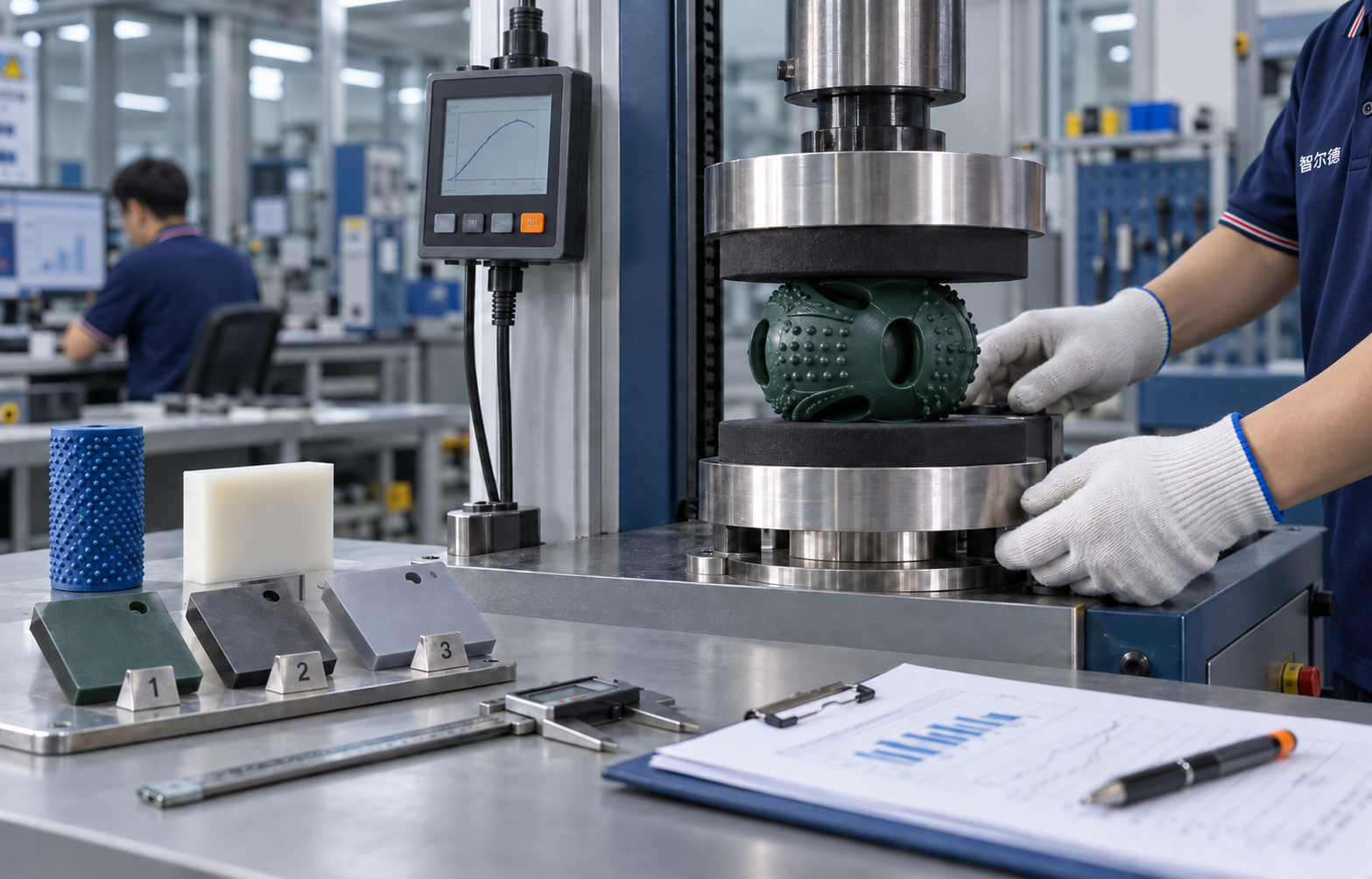 “Chew-Resistant” Is Not a Single Material Specification
 “Chew-Resistant” Is Not a Single Material Specification
Terms such as Light Chewer, Moderate Chewer, Aggressive Chewer and Super Chewer are common in the market, but they are not standardized ASTM or ISO rubber-property grades. Real durability comes from the combination of material properties, geometry, wall thickness, manufacturing consistency and the animal’s actual chewing behavior.
Tensile Strength
Tensile strength is the maximum tensile stress a material can withstand before breaking. Higher tensile strength generally helps a product withstand overall pulling, but tooth damage is often highly localized. Tensile strength alone therefore cannot predict chew life.
Tear Strength
Tear strength reflects resistance to continued crack growth after a cut or flaw already exists. A tooth may first create a local notch; if tear resistance is insufficient, that small defect can propagate quickly. Tear strength is therefore a particularly important property in durable rubber pet-product development.
Elongation at Break
Elongation at break describes how much the material can deform before rupture. Chewing is dynamic loading: the material needs to deform under local pressure, absorb energy and recover as much as possible. High-durability compounds usually require a balance among strength, toughness and flexibility.
Hardness: Higher Is Not Always Better
Increasing Shore A hardness may reduce tooth penetration, but excessive hardness can reduce elasticity, interaction and bite feel and may increase local stress concentration. The objective is not the hardest rubber—it is the right strength–toughness–flexibility balance for the intended use.
ZED’s Three-Level Engineering Development Framework
ZED recommends treating Light / Moderate / Aggressive-Super Chewer as product-development language rather than universal standards. Light applications emphasize softness and elasticity; Moderate applications require stronger tensile, tear and crack-growth resistance while retaining elongation; Aggressive/Super applications require higher tear, tensile, fatigue durability and structural safety margin. Every level must be validated together with wall thickness, radii, holes, parting lines and stress concentrations.
Example Internal Engineering Targets for High-Durability Compounds
For selected high-durability projects, ZED may use approximately 65 ± 5 Shore A, tensile ≥18 MPa, tear ≥60 kN/m and elongation ≥550% as one internal starting point, then refine the target based on geometry and testing. These values are not an industry-wide “Super Chewer” standard and do not constitute a safety or durability guarantee.
Material + Geometry + Manufacturing
Durability development must answer several questions together: Is tear strength sufficient? How easily does a crack propagate? Where are the stress concentrations? Are wall thickness and radii appropriate? Do holes create weak zones? Are physical properties stable after production curing? Chew durability is not one hardness number—it is the result of material science, product geometry and manufacturing working together.
Source / Verification Notes
·ZED internal rubber capability targets and pet-product development experience.
·Editorial caution: Light/Moderate/Aggressive/Super Chewer are market descriptors, not universal ASTM/ISO material classifications.


