
Silicone, Rubber, TPE and TPU: What Is the Difference?
Silicone vs Rubber vs TPE vs TPU: Key Differences | ZED
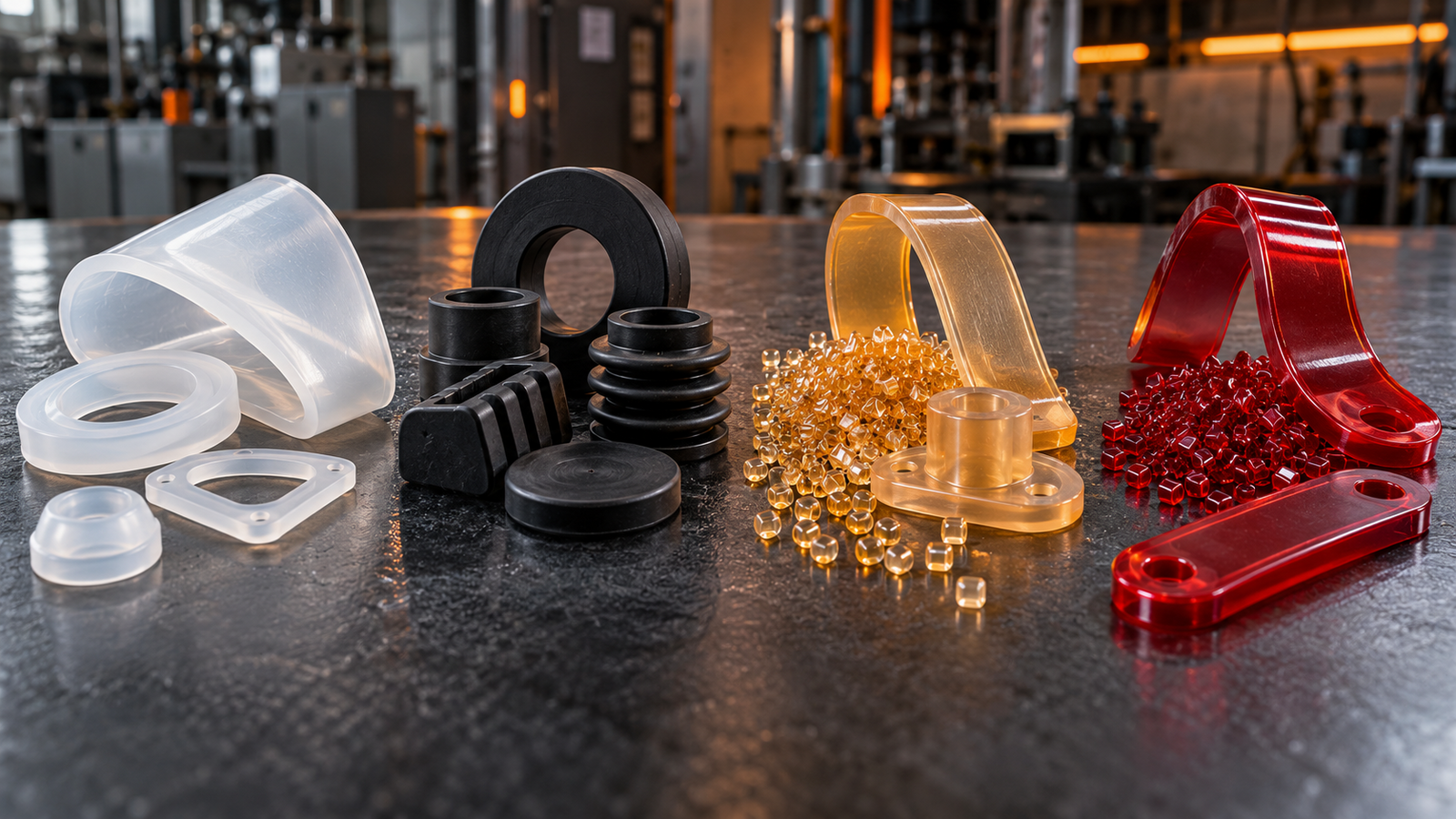
Compare silicone, conventional rubber, TPE and TPU by feel, performance, processing and typical applications before selecting a custom material.
Excerpt: Silicone, rubber, TPE and TPU can all produce flexible products, but they do not behave the same. The right choice depends on performance, processing, geometry and use conditions.
Similar appearance does not mean similar performance
Flexible molded products are often described simply as “rubber.” In practice, the finished part may be made from conventional vulcanized rubber, silicone rubber, a thermoplastic elastomer (TPE) or thermoplastic polyurethane (TPU).
These material families can overlap in softness and appearance, but they differ in processing method, recovery, abrasion behavior, temperature response, surface feel, recyclability of production scrap and compatibility with other materials.
The following comparison is a starting point. Final performance depends on the exact grade and formulation.
Conventional rubber
Conventional rubber materials are crosslinked during molding. Common families include natural rubber and a range of synthetic rubbers selected for different environmental and performance conditions.
Rubber is often considered where the product needs elastic recovery, grip, cushioning, sealing or repeated deformation. Formulation can be adjusted for hardness, color and application-specific performance.
Typical strengths:
Elastic recovery
Broad formulation flexibility
Good grip and cushioning potential
Suitable for compression and rubber injection molding
Strong fit for many molded industrial, footwear and consumer products
Points to review:
Curing conditions and cycle time
Flash and trimming requirements
Odor and color expectations
Compression set and aging behavior
Batch consistency and compound control
Silicone rubber
Silicone is an elastomer family known for its wide temperature capability, stable flexibility and clean surface potential. It is commonly considered for products that face temperature variation, require a specific tactile feel or need a formulation designed around particular regulatory requirements.
However, “silicone” is not one universal specification. Hardness, tear strength, curing system, transparency, color and test requirements must still be defined.
Typical strengths:
Flexibility across a wide temperature range
Good weathering potential
Distinctive soft-touch feel
Available in a range of colors and hardness levels
Points to review:
Tear performance in thin sections
Dust attraction and surface feel
Tooling and curing requirements
Material cost
Exact formulation and applicable testing
TPE: thermoplastic elastomer
TPE combines elastomer-like flexibility with thermoplastic processing. It can be melted and injection molded, which makes it attractive for high-volume products and overmolded structures.
TPE covers a broad group of materials. Different grades can vary significantly in softness, grip, compression behavior, weather resistance and bonding performance.
Typical strengths:
Injection molding efficiency
Broad hardness and tactile options
Potential for overmolding onto compatible plastics
Production scrap may be more manageable than cured rubber, depending on the process and material condition
Suitable for complex molded shapes
Points to review:
Heat response and permanent deformation
Bonding to the substrate material
Oil, chemical and UV exposure
Shrinkage and dimensional control
Surface migration or tackiness in certain formulations
TPU: thermoplastic polyurethane
TPU is a thermoplastic elastomer known for toughness, abrasion resistance and useful mechanical strength. It can be selected for flexible parts that need more wear resistance or structural strength than many softer TPE grades.
TPU grades can range from flexible to relatively rigid. Moisture control before processing is particularly important because improper drying can affect molding quality.
Typical strengths:
Abrasion and wear resistance
Tear strength potential
Good mechanical toughness
Injection molding capability
Useful for flexible yet structurally demanding parts
Points to review:
Material drying and moisture control
Processing temperature
Hydrolysis, UV or chemical exposure depending on grade
Shrinkage and warpage
Desired surface feel and hardness
Quick comparison
| Decision factor | Conventional rubber | Silicone | TPE | TPU |
|---|---|---|---|---|
| Processing | Curing / vulcanization | Curing | Thermoplastic injection | Thermoplastic injection |
| Typical feel | Elastic, grippy | Soft, clean, flexible | Wide range, soft-touch possible | Tougher, often firmer |
| Abrasion potential | Grade-dependent | Usually not the first choice for high abrasion | Grade-dependent | Often a strong option |
| Temperature capability | Depends on rubber family | Often broad | Grade-dependent | Grade-dependent |
| Multi-material molding | Possible with process development | Application-specific | Common with compatible substrates | Possible with compatible substrates |
| Key production issue | Cure and flash control | Tear and cure control | Shrinkage and bonding | Drying and process control |
Which material should you choose?
Choose the material based on the product's critical requirement:
For elastic recovery, grip or sealing, evaluate suitable rubber formulations.
For temperature stability or a silicone-specific feel, evaluate silicone grades.
For efficient injection molding and soft overmolding, evaluate TPE.
For abrasion resistance and flexible toughness, evaluate TPU.
The best choice may also involve a combination of materials—for example, a rigid plastic structure with a soft TPE or TPU functional zone.
Ask for a project-specific comparison
Send ZED your product drawing, performance priorities, target hardness, use environment and expected volume. We can compare realistic material routes alongside tooling and production requirements.


